Showing posts with label culture. Show all posts

Sunday, 18 January 2015

Day 18

you see
that darkness yonder
eventually
we will all get there
so wipe that smile off

Monday, 5 January 2015

Friday, 25 April 2014

V... is for Victorian Literature

I spoke of the lofty thoughts and ideals of Romanticism earlier. This period was followed by the reign of Queen Victoria in Britain, from 1838 to 1901 and this period produced some very significant literary works that I'm required to study. While poetry was the most important form with the Romantics, the novel, as we now know it, became the leading literary genre in the Victorian times. Some of the noteworthy novelists of this period include Dickens, Eliot, the Bronte sisters, and Hardy. There were some great poets too - Browning, Yeats, and Tennyson.
From wiki, I have, "Victorian novels tend to be idealised portraits of difficult lives in which hard work, perseverance, love and luck win out in the end; virtue would be rewarded and wrongdoers are suitably punished. They tended to be of an improving nature with a central moral lesson at heart. While this formula was the basis for much of earlier Victorian fiction, the situation became more complex as the century progressed. There was a struggle to conquer the flaws of human beings with great virtues. It was a principle that those who struggle to attain morality would most probably achieve positive results in the end if not tortured by natural circumstances or evil vices."
Though this period produced a vast array of works, their common themes made them cluster together as the kind of things the reader at the time wished to read. My personal favourite is Dickens, I have read all of his novels barring a couple, and there is something about the way he writes that draws me to the novels.
*****************************************************
This is the twenty-second post for the April A-to-Z Blogging Challenge 2014.
Previously, Archaism, British literature, Critical Analysis, Drama, Edinburgh, Faust, Gothic Fiction, Humour, Interpretation, Journalling, Keats, Language, Metaphysical Poetry, Narration, Ode, Papillion(ed), Quatrain, Romanticism, Shakespeare, Tone, University

Monday, 7 April 2014

F... is for Faust

About three years ago, I went to the Delhi World Book Fair with no TBR list. I walked around with no aim, picking up books that caught my fancy, ones that I'd heard were good, ones that looked like they'd be good etc. Good times... and I was earning at the time, so I splurged! One of the books that I bought and later read was Faust by Johann Wolfgang von Goethe. I knew that it had something to do with Satan, and I really liked the name of the author.
I wasn't disappointed. Faust is the tale of a very learned young scholar, who sells his soul to the Devil and makes a pact with his advocate for years and years of power. In the degree that I'm currently studying towards, I'm required to read The Tragic History of the Life and Death of Doctor Faustus by Christopher Marlowe, same plot. Both texts I have thoroughly enjoyed. There is something truly wonderful and sinister about making a pact with the Devil himself, and I really think that each one of us should be put through that test. No, I'm not religious, but I do like the symbolism of it. And I thoroughly believe that all the so-called enlightened will fail the test.
Anyway, you must read one or both of these works about Faust, they are filled with intrigue and excitement. I have loved the characters and dark dark plot. As one would expect, the ending is tragic. Goethe's Faust is also filled with beautiful and lyrical poetry and is an excellent mix of prose and poetry, great for those who aren't comfortable with a body of work that is complete poetry, like Milton's Paradise Lost.
*****************************************************
This is the sixth post for the April A-to-Z Blogging Challenge 2014.
Previously, Archaism, British literature, Critical Analysis, Drama, Edinburgh

Saturday, 5 April 2014

E... is for Edinburgh

What a disaster! I was away yesterday and this post was scheduled. :( Anyway, here it is now.
*****************************************************
Many of you here don't know me personally. Actually, profession-wise, I'm an Engineer. I have a Masters in Electronics engineering, and while I'm not a complete geek, I like to think that I have a decent analytical brain. I also love Literature and pick up new languages fast, maybe something to do with a good left brain. I got my Masters degree from The University of Edinburgh and it was that time I spent in Scotland that my passion for Literature really picked up. It was also during that time that I decided I was going to study Literature properly, and give my passion a voice.
Edinburgh is a very literary city. There are immense resources for writers, some brilliant book/writing clubs, and endless inspiration. Of course, it helps that nature is predominant in Scotland and very motivating to artists, musicians, and poets. It also helps that Edinburgh itself can also be a very dark and brooding city, with its bloodied past, scary haunting history, and intriguing city-upon-city structure.
Organisations like the Scottish Book Trust and the Scottish Poetry Library promote reading, writing, and generally, the culture of staying associated with good book and good authors. Edinburgh has been a massive inspiration to my literary side, and for that I will always be grateful, and I wrote about that here.
*****************************************************
This is the fifth post for the April A-to-Z Blogging Challenge 2014.
Previously, Archaism, British literature, Critical Analysis, Drama

Wednesday, 2 April 2014

B... is for British Literature

Right at the onset, I would like to say that I'm quite overwhelmed by the lovely comments I got on my post yesterday. It is a beautiful feeling to read them. I'm having a busy day today (my cousin is coming and I'll see him after two years!) but I'll read more blogs tomorrow.
So, like I said, my first year modules for school are all about British literature. And while I've never been one to think of a person's nationality while I read his/her works, I was quite surprised. I have read many of the poets, playwrights, and novelists on my course without thinking that they were British, but they were! So many of them! While it is natural that this should all be happening in the country that gave the world the language itself, but it is still wonderful that they can read, write, and enjoy in their mother tongue.
I've always expressed myself best in English. A rigorous secondary school education coupled with an inherent love for the language ensured that English became my first language. So I would never know what it is like to enjoy studying in a language that is fairly alien, but friends tell me that it is a chore. Anyway, point being that I'm glad the British gave us this wealth of Literature and that I finally got around to studying it. Another happy coincidence is that the course creators have included Sylvia Plath, who was married to an Englishman. I do like her works.
In case, you're wondering, for second year, we were given optional modules to choose from Indian, Canadian, Australian, and American Literature. I chose American (Hemingway, Twain, Fitzgerald, Capote sigh) and Australian (because I have NO idea what it contains!).
*****************************************************
This is the second post for the April A-to-Z Blogging Challenge 2014.
Previously, Archaism

Tuesday, 1 April 2014

A... is for Archaism

As the immortal song goes "Let's start at the very beginning / A very good place to start"...
By a series of chance encounters, coincidences, and timing clashes, I'm studying towards a Masters in Literature. Finally, I say! It has been a long time coming, this chance meeting with Literature. But it is here now, and how!
My modules include largely British literature, it is where 'English' began, where it took form, and went through all of its many recognisable phases. I am reading a lot of archaic literature, as a result. Derived from the Ancient Greek: archaîos means 'from the beginning or ancient'. It is the use of a form of speech or writing that is no longer current.
Chaucer, for instance, I'm losing hope with. I don't think I will ever enjoy him. But Donne, I love. "Wuthering Heights' I'm reading for the first time, but 'Great Expectations' is like meeting an old friend who I know page by page. But my newest experience has been the study of the Structure of language itself. Asking the questions of 'What is language?', 'Why do we need it?', 'How to understand and construct criticism?' etc, have been proving to be wonderful exercises.
Archaism and its ideas which seem hardly relevant in today's modern world is an integral part of learning the language. It is imperative to understand where what we read today comes from. However outdated and illogical characters and plots seem, they provide a succinct glimpse of life and times of their inception.
I will leave you with this poem by Donne, considered very outrageous upon its publication, for what it suggests.

The Flea

Mark but this flea, and mark in this,
How little that which thou deniest me is;
It sucked me first, and now sucks thee,
And in this flea our two bloods mingled be;
Thou know’st that this cannot be said
A sin, nor shame, nor loss of maidenhead,
    Yet this enjoys before it woo,
    And pampered swells with one blood made of two,
    And this, alas, is more than we would do.

Oh stay, three lives in one flea spare,
Where we almost, nay more than married are.
This flea is you and I, and this
Our mariage bed, and marriage temple is;
Though parents grudge, and you, w'are met,
And cloistered in these living walls of jet.
    Though use make you apt to kill me,
    Let not to that, self-murder added be,
    And sacrilege, three sins in killing three.

Cruel and sudden, hast thou since
Purpled thy nail, in blood of innocence?
Wherein could this flea guilty be,
Except in that drop which it sucked from thee?
Yet thou triumph’st, and say'st that thou
Find’st not thy self, nor me the weaker now;
    ’Tis true; then learn how false, fears be:
    Just so much honor, when thou yield’st to me,
    Will waste, as this flea’s death took life from thee.
*****************************************************
This is the first post for the April A-to-Z Blogging Challenge 2014.

Thursday, 25 April 2013

V... is for Venison!


Venison is one of the many things I ate for the first time when I got to Scotland. To be honest, I am no cook, so I don't have any recipes of my own. But I do enjoy the very occasional cooking of something that takes a while but tastes delicious. So, here is a recipe that I wish to try someday. I had it at the hostel that I stayed at in Skye and oh my goodness, it was fantastic!

Venison Sausages Braised in Red Wine
  from Millbank Parkland Venison

Enjoy!
-----------------------------------------------------------------------------------------------------------
This post is part of the ongoing A-to-Z Challenge. Previously, AyeBerwickCramondDisabilityEdinburghForth BridgeGlasgowHamishIsle of SkyeJohn o' GroatsKirkLoch Lomond and LussMogwaiNecropolisOld Man of StorrPortobelloQueen of ScotsRobert BurnsStirlingTantallon Castle, Urquhart Castle.

Tuesday, 16 April 2013

N... is for Necropolis!


There is something infinitely sinister about the world Necropolis, City of the Dead. Dark, depressing, and creepy are the feelings I'd associate with the word. The Glasgow Necropolis is all those feelings, and one more, that of sheer beauty.
For a bit of background, Wiki says, "Following the creation of Père Lachaise Cemetery in Paris a wave of pressure began for cemeteries in Britain. This required a change in the law to allow burial for profit. Previously the parish church held responsibility for burying the dead but there was a growing need to give an alternative solution. Glasgow was one of the first to join this campaign, having a growing population, with fewer and fewer attending church. The planning of the cemetery began formally by the Merchants' House of Glasgow in 1831, in anticipation of a change in the law. The Cemeteries Act was passed in 1832 and the floodgates opened. Glasgow Necropolis officially opened in April 1833."
This place is stunningly beautiful. Among the buried are actors, musicians, and scientists. Almost every grave has a massive and prominent tombstone, mostly having something to do with the profession of the person buried there. This place is free and very close to the city center, so if you are, say, changing trains or have a couple of hours in Glasgow, go to this place. I have seldom felt so powerless and humble in front of anything that is man made.


-----------------------------------------------------------------------------------------------------------
This post is part of the ongoing A-to-Z Challenge. Previously, AyeBerwickCramondDisabilityEdinburghForth BridgeGlasgowHamishIsle of SkyeJohn o' GroatsKirkLoch Lomond and Luss, Mogwai.

Friday, 5 April 2013

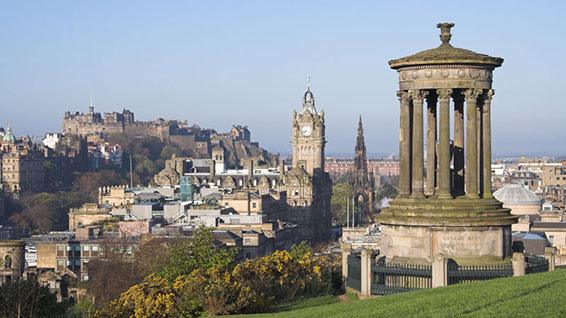
E... is for Edinburgh!

When I got here, I came via London. I had a nightmarish time at Heathrow, didn't have to get out of the airport, and flew on to here. I had no internet, no phone connection. I had a piece of paper with an address on what was going to be my flat. I took a cab.
It was sunny and windy. It was unreal. It was poetry in motion. It was so gorgeous, like nothing I'd seen before. I started Uni, started living my foreign life, got along brilliantly with my lovely foreign flatmates, and stopped converting currency in my head!
I  love this city to bits, love its people, its cobbled streets, its slow moving traffic, architecture, feel. I love the terrible weather, the occasional gorgeous sunshine. If I had my way, I would definitely never leave, or realistically, not leave for a very very long time. Some photos, all from Facebook...

Skyline

Hogmanay 2012 - 13

Old College, Uni of Edinburgh

McEwan Hall, this is where I'll graduate

From Wikipedia "Edinburgh is the world's first UNESCO City of Literature and the city's Old Town and New Town are listed as a UNESCO World Heritage Site. It is considered one of the most beautiful cities in the world and regularly polls as one of the best places to live, having won more than 12 UK Best City Awards in 8 years to 2013. Attracting over one million overseas visitors a year, Edinburgh is the second most popular tourist destination in the UK and was voted European Destination of the Year at the World Travel Awards 2012."
I've written some more about my experiences here and here.

-----------------------------------------------------------------------------------------------------------
This post is part of the ongoing A-to-Z Challenge. Previously, AyeBerwickCramond, Disability.

Thursday, 4 April 2013

D... is for Disability


I've travelled a lot around India, and if you have any idea of India, then you'll believe me when I say, very little surprises me. One of the most stark things that stared me in the face when I came to Scotland was, disability. So many people, both young and old, rich and poor, native and foreign origin, seemed to be disabled. What on earth was going on? And why? I wondered for a few weeks... I thought on the lines of genetic factors, social and environmental factors, and various other things before the answer hit me.
It wasn't at all that more people were disabled here; it was that I ran into more disabled people, because they were out and about. They were in buses, on the streets, in the supermarkets, at cafes. They were in castles and cathedrals, shops and cinemas, and they were leading normal lives. This realisation was a harsh one... for in India, the disabled are hidden away and cloistered, most building still don't have access for disabled people...
I like that the Government here helps people. It is kind. It is on the rest of us.
I took this picture on a bus, by stealth, because he looked like a pukka Scot, had quite a fiesty personality :)
and was on a motorised wheelchair (which went vroom vroom!). He nodded off to sleep, the darling man...


Update: I have since found out that this is Tom Gilzean, do read about him here. What a man!
-----------------------------------------------------------------------------------------------------------
This post is part of the ongoing A-to-Z Challenge. Previously, AyeBerwick, Cramond.

Monday, 1 April 2013

A is for Aye!

Oh yes, that's the word all Scots use. Okay, a bit of background. I come from India, in particular, Bengal. Now, Bengal has had a very heavy British influence, and so, as compared to the rest of India, people in Bengal know wayyyy more about British people, their ways and customs and things. Now when you move to a different country for the first time in your life, you hear things about it, what it's like, what the people, the country, the weather is like, what they sound like, and such other things. I did too.
And then, when I got to Scotland, I was amazed! Everything seemed to match with what I'd heard, except for the people. They were friendly, and laughed loudly, helpful, very very enthusiastic and welcoming, absolutely adorable, and highly unlike what I'd assumed they would be like, quiet and reserved. I asked for directions, 'Aye' they'd say, and proceed to walk me to where I needed to go. 'I didn't think you people here were like this!' 'Aye, they'd say, we know! That's what the English are like!'
Scotland, good people, is very very different from England. People are warm, unlike the weather, which never is. They are also slow, in a good way, in the way they get to know someone, in how they drive, in how they repeat themselves because their accent is so different, but not how they drink ;)
Aye, they say to everything :D

The first time I was lost, in Bonnyrigg. The bus guy gave me a guided tour on
the way back to my place about 5 miles away, and didn't charge me a ticket